
Unpracticed Memory
Socrates noticed what would be one of the great themes of the modern world nearly 2,400 years ago

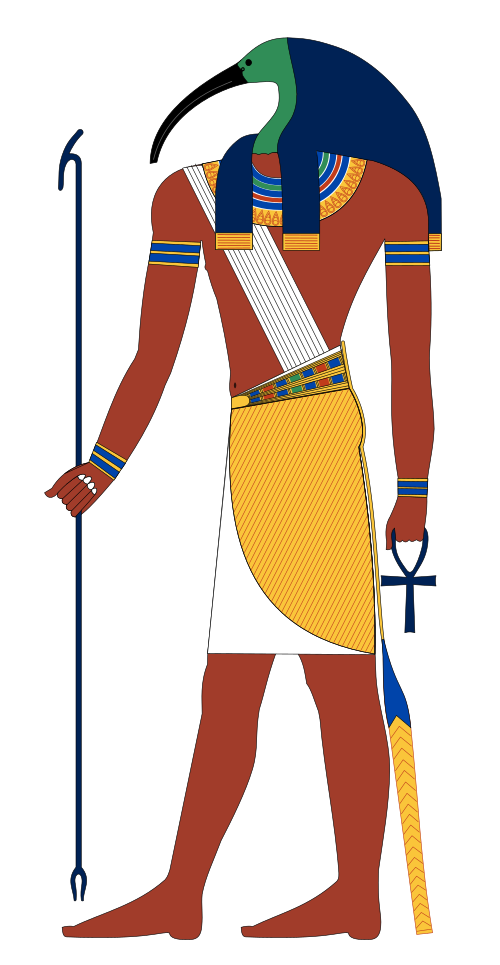
Thoth (or Theuth), ancient Egyptian god often depicted as an ibis-headed man. Based on New Kingdom tomb paintings. By Jeff Dahl - Own work, CC BY-SA 4.0, https://commons.wikimedia.org/w/index.php?curid=3281384
Around 370 BCE, the great Athenian philosopher Plato wrote a trilogy of dialogues, Phaedrus, Republic, and Symposium. Each features his late mentor, Socrates, in discussion with other citizens. Nearly 2,400 years later, it is difficult to say for sure if the dialogues were closely based on memories of real conversations or are fictionalised and re-imagined accounts.
Phaedrus is set in the outskirts of Athens. Socrates runs into a friend. After a little gentle nudging from Socrates, Phaedrus - who complains of his “unpracticed memory” - repeats a speech he has heard earlier in the day from Lysias as the two men sit under a tree. The philosopher’s friend ends up reading the speech from a scoll. The two men then discuss the speech and mull over some of the themes; as well as in the difficulties of the feats of memory that had been regarded as commonplace by previous generations but were now seen as coming under threat.
One of the most interesting passages for modern readers comes towards the end. Plato’s prose is famously dense, so I will break one long paragraph down into smaller chunks. Socrates, who conducted philosophy as a spoken activity rather than as a written one, sets the scene with an Egyptian legend:
At the Egyptian city of Naucratis, there was a famous old god, whose name was Theuth; the bird which is called the Ibis is sacred to him, and he was the inventor of many arts, such as arithmetic and calculation and geometry and astronomy and draughts and dice, but his great discovery was the use of letters. Now in those days the god Thamus was the king of the whole country of Egypt; and he dwelt in that great city of Upper Egypt which the Hellenes call Egyptian Thebes, and the god himself is called by them Ammon.
To him came Theuth and showed his inventions, desiring that the other Egyptians might be allowed to have the benefit of them; he enumerated them, and Thamus enquired about their several uses, and praised some of them and censured others, as he approved or disapproved of them.
It would take a long time to repeat all that Thamus said to Theuth in praise or blame of the various arts. But when they came to letters, This, said Theuth, will make the Egyptians wiser and give them better memories; it is a specific both for the memory and for the wit.
Thamus replied: O most ingenious Theuth, the parent or inventor of an art is not always the best judge of the utility or inutility of his own inventions to the users of them. And in this instance, you who are the father of letters, from a paternal love of your own children have been led to attribute to them a quality which they cannot have; for this discovery of yours will create forgetfulness in the learners' souls, because they will not use their memories; they will trust to the external written characters and not remember of themselves.
The specific which you have discovered is an aid not to memory, but to reminiscence, and you give your disciples not truth, but only the semblance of truth; they will be hearers of many things and will have learned nothing; they will appear to be omniscient and will generally know nothing; they will be tiresome company, having the show of wisdom without the reality.
Socrates and Phaedrus were living in a highly verbal world that was changing fast. Some percentage of male citizens could read and write, to a certain extent, particularly among the wealthy, among those drawn to philosophy, and among merchants. Even so, reading silently in private would have been considered deeply eccentric. Texts were often read aloud in company, as Phaedrus does with the speech.
Let’s fast forward to the modern world. It should be obvious that Socrates was right. Few of us train our memories nowadays. We are indeed “hearers of many things,” but not much of it sticks. Philosophy - the love of wisdom - is often noticeable by its absence in a world that can be superficial and glib.
Sadly, I am myself an example. I first read Socrates’ passage on the dangers of reading about three decades ago as a young man during a Philosophy degree. Although the observation stuck in my mind, please don’t ask me to recite the passage! Indeed, I had to ask ChatGPT to remind me of the name of the dialogue where it can be found. I then looked up an English translation of the original text and the Wikipedia entry on the internet. I still managed to mis-spell Phaedrus as I drafted this essay, but luckily a lifetime in journalism has taught me to double-check all proper names before pressing send.
Although I remembered the core of the passage for three decades, if not the details, it is worth noting that I did have a little help on the way. I checked my Amazon account and it tells me that I downloaded the Kindle version of Power of Reading by Frank Ferudi in March 2016, when I was in the middle of the research project that evolved into this blog (I started publishing essays in December 2020). Amazon’s website let me click through and re-read Ferudi’s passage on Socrates’ warning about how reading would undermine memory to help me draft this very paragraph.
This tech - ChatGPT, websites, Wikipedia, Kindle, Amazon, the internet itself, personal computers - effectively acts as “external written characters,” as Socrates warns of scrolls. As a result of the combined power of these tools, I have no great need to work my own memory as if it were a muscle, although I do store away nuggets like “Socrates on the dangers of reading” and remember how to look up references.
In a 2017 book, The Knowledge Illusion, authors Steven Sloman and Philip Fernbach suggest that humans store very little knowledge in our own heads. Instead, we tend to rely on “knowledge stored elsewhere: in our bodies, in the environment, and especially in other people. When you put it together, human thought is incredibly impressive. But it is a product of community, not of any individual alone.”
So, we tend to walk through life with weak memories. Instead, much of our knowledge is stored in the world around us. We need to remember that it is there and how to access it. For example, if you want to find a route nowadays, you need to remember where you left your mobile, the PIN to get in, where you stowed the Google Maps app, and where you are going. You don’t need to remember the route*.
The key word here to understand what we are all doing is externalisation. Many generations ago, our ancient ancestors started on this path when they started using tools systematically. Socrates was insightful enough to realise what was happening from clues like friends reading speeches on scrolls instead of memorising them. The benefit to externalisation is that we get access to much more information than previous generations would have thought possible. This can lead to compound economic growth, transforming societies. The risk is a certain superficiality, as we skim the surface of multiple texts rather than engaging deeply with one.
Many of the debates that we have nowadays about artificial intelligence (AI), including tools like ChatGPT and Amazon’s algorithmic search function, can be understood in this context. Our species is once again externalising what used to be done within our heads. Once these externalised elements exist in the world, there is a risk of them developing autonomous lives of their own (a process sociologists call reification) as our own abilities atrophy. The comments are open. See you next week!
*I must confess that I like to drive around without a GPS most of the time. I see getting lost as an exciting way of gaining more data about incorrect routes. This drives various family members up the wall!
Previously on Sharpen Your Axe
Further Reading
Power of Reading: From Socrates to Twitter by Frank Ferudi
Phaedrus by Plato
The Knowledge Illusion: Why We Never Think Alone by Steven Sloman and Philip Fernbach
This essay is released with a CC BY-NY-ND license. Please link to sharpenyouraxe.substack.com if you re-use this material.
Sharpen Your Axe is a project to develop a community who want to think critically about the media, conspiracy theories and current affairs without getting conned by gurus selling fringe views. Please subscribe to get this content in your inbox every week. Shares on social media are appreciated!
If this is the first post you have seen, I recommend starting with the fifth-anniversary post. You can also find an ultra-cheap Kindle book here. If you want to read the book on your phone, tablet or computer, you can download the Kindle software for Android, Apple or Windows for free.
Opinions expressed on Substack and Substack Notes, as well as on Bluesky and Mastodon are those of Rupert Cocke as an individual and do not reflect the opinions or views of the organization where he works or its subsidiaries.
Yeah, maps....And phone numbers. We used to remember them and would have may "stored" internally (ie, memorised) for quick, easy use. I still remember the phone numbers of my childhood friends. No more.
That said, old Thamus was a bit of a party pooper.
The pattern always repeats itself: new technology = cheating. Memorizing vs. writing, the scribe vs. the printing press, artist vs. photographer, skilled tradesmen vs. the assembly line, the library vs. the internet, and now all of that which went before vs. AI. Technologies change, arguments stay the same.