
Violence and Surrender
An essay on the flaws of pacifist reasoning

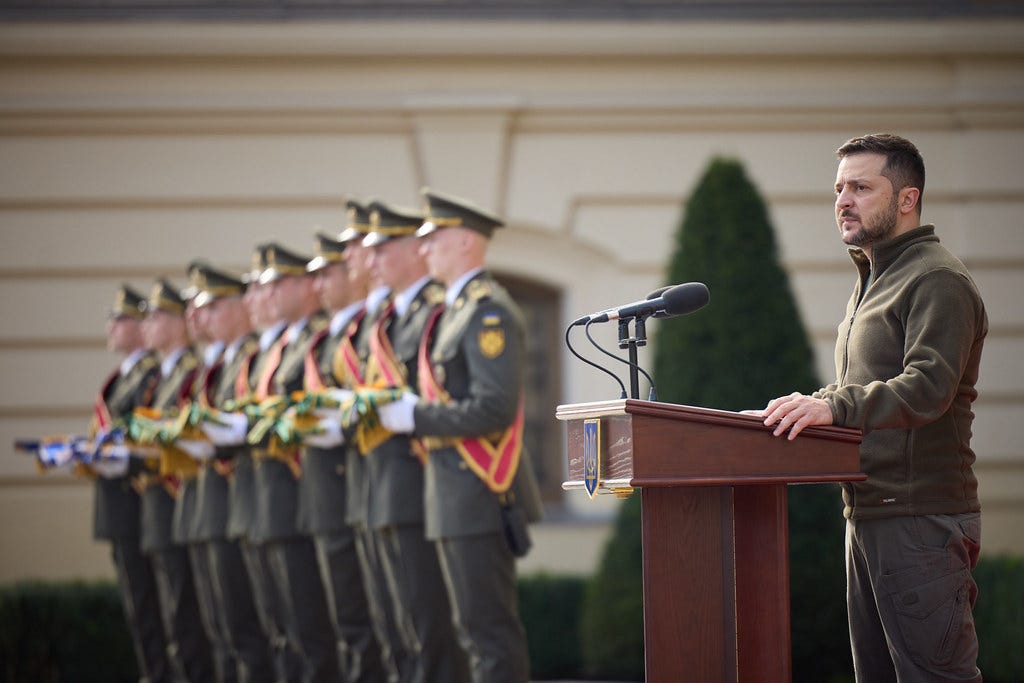
"On Day of Defenders of Ukraine President presents orders of Gold Star, Cross of Combat Merit awards, awards military units with honorary titles." by President Of Ukraine is marked with CC0 1.0.
A reader asked an astute question following the essay on personal safety in politics. Do I think that Volodymyr Zelenskyy, Ukraine’s President since 2019, should have surrendered to Russian forces in February 2022 when Vladimir Putin invaded his country? Wouldn’t this have been justified as a way of keeping the population safe?
My answer is a resounding no. One of the hardest truths those of us who have flirted with pacifism at some point in our lives have to learn is that surrendering does not necessarily lead to less violence.
We can see this clearly on a micro level. Self-protection experts will always advise people that if a violent criminal wants to remove us to a secondary crime scene, we should never agree. Fight for your life! Your odds will always be better in a public place than in a location of the criminal’s choosing.
The same is true at a macro level. If Ukraine had surrendered in 2022, Putin would have been likely to incorporate it into an empire and then apply universal conscription within his domain. Young Ukrainian men would be expected to fight in his next war, whether that was in the Baltic States, or the Caucasus, or elsewhere in Eastern Europe.
This is the way that empires work. For example, more than 7m Ukrainians served in the Soviet Union’s Red Army during World War II. The historical record is clear.
On the other hand, if Ukraine is able to defeat Russia in the field and then joins both the European Union (EU) and the North Atlantic Treaty Organization (NATO) - assuming the latter survives Donald Trump’s second presidency of the United States (US) - then future generations of young Ukrainian men can expect to live out their full lives in peace, with minimal or no military obligations.
Zelenskyy and Ukraine didn’t choose the war with Russia. However, once war has been declared, then fighting to win is the least bad choice. What do you think? The comments are open. See you next week!
Previously on Sharpen Your Axe
Further Reading
The Oak and the Larch: A Forest History of Russia and Its Empires by Sophie Pinkham
This essay is released with a CC BY-NY-ND license. Please link to sharpenyouraxe.substack.com if you re-use this material.
Sharpen Your Axe is a project to develop a community who want to think critically about the media, conspiracy theories and current affairs without getting conned by gurus selling fringe views. Please subscribe to get this content in your inbox every week. Shares on social media are appreciated!
If this is the first post you have seen, I recommend starting with the fifth-anniversary post. You can also find an ultra-cheap Kindle book here. If you want to read the book on your phone, tablet or computer, you can download the Kindle software for Android, Apple or Windows for free.
Opinions expressed on Substack and Substack Notes, as well as on Bluesky and Mastodon are those of Rupert Cocke as an individual and do not reflect the opinions or views of the organization where he works or its subsidiaries.
Buddhism is often thought of a pacifist. Yet (my understanding anyway) if we let an aggressor act violently we are abetting their bad karma. Better to stop them. By any means necessary
A desire to make peace has merit. But it has to be peace, not just the official lack of war.
If someone wants an end to war but doesn't care about the details, such people killed by occupation forces, they're being swayed by aesthetics over substance.
https://chakhoyan.substack.com/p/when-wishing-for-peace-brings-war