
Inexorable
An essay on five secular trends that are likely to define our society in the decades to come

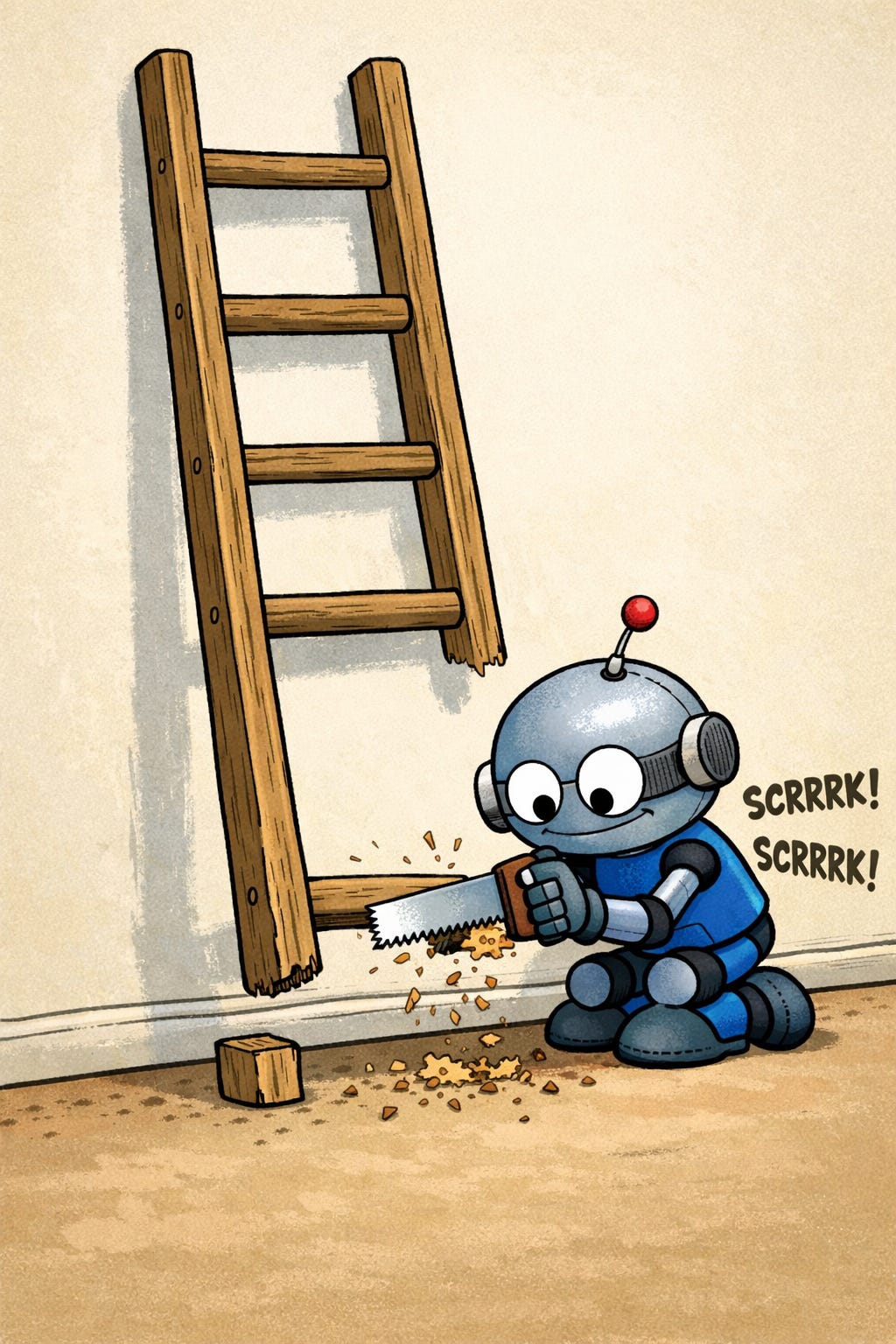
Image generated by ChatGPT
adjective formal uk /ɪˈnek.sər.ə.bəl/ us /ˌɪnˈek.sər.ə.bəl/
continuing without any possibility of being stopped
In my day job as a financial journalist, I always sit up and take notice whenever anyone mentions a “secular” trend. The word refers to changes that are expected to take place slowly but persistently over the long term. We might not always know the pace, but the general direction of travel is often clear. These trends stop short of being inevitable, but they can be very hard to reverse.
This week’s essay will look at five large secular trends that I think we are already seeing; and which are likely to become significantly more important to all of us in the decades ahead. Will we be able to future-proof ourselves? Please read on!
The Missing Rung
In February, the CEO of Microsoft’s artificial intelligence (AI) arm, Mustafa Suleyman, said that AI is on the brink of achieving “human-level performance on most, if not all, professional tasks.” He said accountancy, law, marketing, and even project management would be vulnerable within 18 months.
Whether or not Suleyman is right about the timing, the direction of travel is clear: automation is coming for white-collar jobs, just as offshoring came for blue-collar jobs. Society was able to survive the shock of lost factory jobs because it impacted a minority of the workforce, while making goods cheaper for the rest of us. However, more than 60% of the US workforce have white-collar jobs, making the impact of AI on society as a whole potentially much more troubling.
I strongly suspect that Suleyman is being too optimistic/pessimistic about the timing. Whether or not that is the case, I think we can all agree that entry-level jobs for young people will be hit first. It will become much harder to get a foot on the ladder if we remove the bottom rungs.
At the same time, societies throughout the West consistently fail to build enough new homes, which means that property prices will always tend to go up over time, making it increasingly hard for young people to buy their first flats.
Investing in education used to be one of the best uses of cash to prepare for the uncertainties of a market economy. If we see the destruction of white-collar work on a massive scale, starting with entry-level jobs, the return on investment of a university degree might not be quite as clear as it used to be in the past. I suspect that post-graduate education will maintain its prestige, to a certain extent, while high-school diplomas by themselves will become even less valuable.
Having said that, it will be harder to know exactly what subjects to study. Learning to code used to be excellent advice until generative AI (Gen AI) made vibe coding possible, for example.
People who can adapt fast to new opportunities (and abandon doomed skillsets without getting sentimental about sunk costs) will almost certainly have an advantage over others in the world that is to come.
We can see this clearly with the rise of vibe coding. While it could be very bad news for professional coders, using AI to write code for free or very cheaply will make life much easier for aspiring entrepreneurs with clever ideas, even though it will make it harder to defend successful projects against even newer entrants. The creative destruction at the heart of capitalism is likely to step up a gear.
If it becomes harder to sustain a career over the course of decades, I think we can expect to see many more people seeking to become financially independent with a burst of entrepreneurial activity in their teens, twenties, or thirties.
As well as creating opportunities for entrepreneurs, AI will clearly create new roles that are difficult to predict with the information available at the moment. Many jobs will also sit upstream of automation, particularly executive and senior roles, which will increasingly see AI as a sparring partner. Also, people who own shares in the companies that manage to unlock massive revenues from automation will do very well indeed, even if their own careers wobble.
It should be obvious that the people who are able to survive and thrive in the AI era will want to pay a premium for experiences that make them feel truly alive. Any young people wondering where to specialise should spend some time thinking about “the experience economy,” as well as those aspects of healthcare that emphasise in-person care by human beings rather than robots.
You don’t need to read too many history books to realise that armies of unemployed men without property or life partners can be a destabilising force in society. Expect the brightest politicians to explore old-fashioned ideas around national service or paid apprenticeships as societies struggle to adapt to these new technologies.
At the same time, I would expect surprisingly large numbers of disappointed young people to decide to move into cheap property in small villages and then live a quiet and inexpensive life in beautiful natural surroundings. Some of them will be ex-entrepreneurs who became financially independent first.
If today’s young people have to struggle with decades of instability while failing to get a foot on the property ladder, or opt out of the rat race in the countryside, we can expect the inter-generational transfer of wealth to become increasingly important to society. Older generations that managed to save a little money every month for decades while paying off the mortgage will be sitting on assets that represent a significant change in the lives of their children or grandchildren.
Sadly, not every estate will be robust enough to survive a period in an expensive care home at the end of life, adding another element of instability into the mix.
Where Are the Babies?
There is a global trend of young women having fewer babies. For most of human history, people have lived in the countryside without access to effective contraception and with high levels of child mortality. This has reversed in recent decades.
The world’s urban population is estimated to have exceeded the rural population in 2007; contraception is affordable and easily available in much of the world; and infant mortality has plunged. As a result, parents throughout the world often choose to invest more in fewer children.
These trends are particularly acute in the West and Japan, where natality is often below the replacement rate. Governments around the world have tried many experiments to see how to reverse these trends, but no clear winners have emerged yet. The instability mentioned in the previous section is likely to exacerbate this trend in the future. Young adults struggling to establish careers or buy property are probably less likely to have babies than they would have been in other circumstances.
The one solution that does yield results is massive immigration from poorer regions with high birth rates, particularly from countries in Africa. Many of the newcomers are likely to seek work in embodied jobs that are further away from automation than accountancy, the law, or marketing. Examples include driving taxis, working on building sites, or looking after the elderly in care homes.
Sadly, though, the presence of immigrants from poor countries often generates a backlash among the native-born. These resentments are carefully nurtured by the anti-immigrant hard right. Anti-immigrant narratives might win the odd election (or referendum) now and then, but they can prove insufficient as a platform for government for one simple reason: if you block immigration, the pensions system becomes unstable without unpopular reforms. Of course, annoying pensioners is a terrible strategy if you want to win elections in an aging society.
It is difficult to predict how these tensions will play out over the long term. I expect we will probably see left-wing and right-wing governments alternating in power for many decades while engaging in fierce arguments over immigration, just as the left and right have argued over the balance between welfare and growth in previous decades. If this is correct, we can expect the left to often encourage immigration to keep the pensions system afloat, while the right will take a harder line on newcomers. Neither side will be much loved by the electorate.
I suspect that the Middle East model, with a two-tier system involving citizens and guest workers, could end up being imported into the West (and maybe Japan too). Of course, the guest workers will tend to be young, and will want to raise families. Can societies find a way to make this model work? I suspect any experiments will yield imperfect results, with many unforeseen consequences along the way.
Weird Culture, Weird Politics
The internet became mainstream during the 1990s. One of its major effects has been to destroy the influence of gatekeepers, like newspaper editors or television news producers. As a direct result, our culture has become more diverse and much weirder. This accelerated with social media, which lets like-minded people with fringe views find each other.
We saw this clearly with COVID-19. A new disease burst onto the scene from a market or a research lab (we don’t know for sure), leading to serious risks for the elderly and others. Governments imposed lockdowns around the world as researchers raced to develop vaccines based on recombinant DNA (rDNA) tech, which they realised could be used to train our immune systems. The innovation was wildly successful, but led to a backlash, with some people buying into strange internet theories about the disease allegedly being caused by 5G mobile towers and the vaccine allegedly including tracking devices.
Some of the anti-vaxxers got so organised that they turned into an electoral force. One of them ended up as Health Secretary of the US. He promoted healthy living by recording a video of himself showing off the torso he built with steroids while riding an exercise bike. In a sauna. In jeans. Alongside a country rock star, who once wrote a song saying sex with minors should be considered “mandatory.” The singer also once told an interviewer that men should be able to sleep with 14-year-old girls. I, for one, didn’t have the latest stages of this saga on my bingo card for 2026!
Politics clearly sits downstream of culture. As our culture gets weirder and more diverse, we can expect the same to happen to our politics. Discredited ideas are likely to get a new lease of life, the same way that vaccine hesitancy did.
We can expect anti-capitalism to come back into vogue as automation reeks havoc on white-collar jobs. Unfortunately, hatred of markets is unlikely to improve society if and when anti-capitalists win elections. Having said that, the populist right will probably find defending billionaires becomes very uncomfortable indeed at a time that AI is generating instability in the lives of much of the electorate. Expect the “progressive” left to have fun developing anti-automation narratives.
As populists of left and right pick battles over immigration, AI, automation, billionaires and other culture-war themes, the rest of us can only hope that the guardrails of liberal democracy will do what they were designed to do.
Tech is likely to remain a wild card in the years ahead. Someone somewhere is working on something that will revolutionise society as you read this. Who is the lucky entrepreneur or inventor who will turn everything on its head? Where is he or she based? What, exactly, is the tech? Will it lead to a backlash?
I am afraid I have no idea whatsoever, but you can be absolutely sure that the future is being reinvented in a lab or startup office somewhere right now. We will only see the headlines once the technical breakthroughs have been made.
Electrification, Weather, and Climate
Climate change is real. As a technical problem, it is probably solvable for a species as innovative and restless as ours. However, we are also prone to cognitive dissonance (an uncomfortable feeling we all experience when faced with contradiction).
As a result of both the power of our tech and the strength of our cognitive dissonance, we can always expect to take two steps forward and one step back. Huge technical advances will reduce emissions of greenhouse gases while environmental policies will provoke an inevitable backlash among some voters. My bet is that these factors mean that we will probably avoid the most extreme scenarios, but that extreme weather events will become more common.
Electrification is likely to become increasingly common as we struggle with these issues. We can expect to see electric vehicles (EVs) gain market share, while the need for lithium for batteries will help countries with large reserves, like Bolivia. At the same time, sovereign wealth funds from the Middle East have been using revenues from oil to diversify into more modern industries for many years.
We have already mentioned that the disruption caused by AI will probably make a simple life in the countryside attractive to many. Cheaper and more efficient solar panels and home batteries can be expected to play a part in enabling this trend.
The French model shows that nuclear power could well be a key future underpinning electrification. We could have electricity that is too cheap to meter if our politicians took a series of sensible decisions; and the electorate finds a way of avoiding hucksters selling a backlash.
Mafia Markets
Back in 1947, economist Friedrich Hayek convoked a group of his peers at a Swiss resort to defend old-fashioned economic liberalism. The meeting led to a new group, called the Mont Pelerin Society, which would lobby against an interventionist government in the West. Its ideas began to gain traction in the 1980s and 1990s.
The high watermark came in 2003 with the US invasion of Iraq. The bizarre decision not to make a plan for the change of regime can only be understood once you realise that the people who neglected such an essential step had been steeped in Hayek’s work on “spontaneous order” - the emergence of order out of chaos in a market economy, seemingly by magic.
Former communist economies in China and what used to be the Soviet Union adopted capitalism in the 1990s, but the leaders who led the reforms neglected to study Hayek’s lessons. The result was a new forms of illiberal capitalism, whether state-led in China or gangster capitalism in the case of Russia. Recent developments on the populist right can be understand of attempts to import this new understanding of capitalism back into the West.
I suspect that once gangster capitalism has been let loose, it will be very difficult to get the cat back into the bag. What will be the consequences? First of all, we can expect to see billionaires and oligarchs increasing their interest in electoral politics. In a gangster economy, state power outguns economic power. It will be safer for billionaires to try and run the government than to work outside it.
Secondly, we can also expect to see gangster capitalism being implemented in a patchy way throughout the West. The countries or regions that are able to resist the longest will have a certain advantage, as genuine innovators will always prefer to live in societies where arbitrary arrest or the arbitrary loss of wealth are least likely.
It will prove very difficult to revive the international rules-based order, I suspect. Although always imperfect, it will be missed sorely. Smaller and medium-sized states are likely to club together; and the proliferation of nuclear weapons around the world will add an element of uncertainty that will be very familiar to those of us who were young in the 1980s. Meanwhile, killer drones operating autonomously on the battlefield of the future, based on agentic algorithms, will give us something new to worry about.
The world is also likely to continue to splinter into spheres of influence led by a handful of superpowers. Even so, it is hard to see the US dropping its interest in the Middle East any time soon, as we no doubt all realised with the latest round of hostilities against Iran.
Having said that, I expect the European Union (EU) will very gradually get its act together in the years ahead. I would bet against those who think Russia will dominate Europe. Its invasion of Ukraine shows that is not the military powerhouse that many assumed it to be just a few years previously.
A couple of weeks ago, the New York Times carried an interesting quote from Christian Mölling, founder of the Berlin-based think tank European Defense in a New Age, who made a very pithy point about how Europe could defend itself even if it loses full access to American military tech. “We don’t need to be better than the US, we need to be better than Russia.”
Russia’s failed attempt to annex Ukraine has shown the world that the future of warfare will be based on drones and counter-drone warfare. Rare earths will play a critical role in underpinning this tech. China will have a definite advantage on this front, but the shifting nature of warfare will make access to African minerals a very important theme in the years to come.
Are there any other secular trends that we should think about? Did I misread any of the trends I have mentioned today? The comments are open. See you next week!
Previously on Sharpen Your Axe
Natality (part one and part two)
Climate change as a technical problem
Electrification and EVs and lithium
This essay is released with a CC BY-NY-ND license. Please link to sharpenyouraxe.substack.com if you re-use this material.
Sharpen Your Axe is a project to develop a community who want to think critically about the media, conspiracy theories and current affairs without getting conned by gurus selling fringe views. Please subscribe to get this content in your inbox every week. Shares on social media are appreciated!
If this is the first post you have seen, I recommend starting with the fifth-anniversary post. You can also find an ultra-cheap Kindle book here. If you want to read the book on your phone, tablet or computer, you can download the Kindle software for Android, Apple or Windows for free.
Opinions expressed on Substack and Substack Notes, as well as on Bluesky and Mastodon are those of Rupert Cocke as an individual and do not reflect the opinions or views of the organization where he works or its subsidiaries.
I think everyone involved in the markets is trying to get their arms around the latest trends. It's not a pretty picture. An AI-driven, two-tiered economy targeting a meme-driven, factcheck-avoiding populace driven by gangster capitalism.
Sadly, my first thought was to look at this as an investor. But you're really talking about the end of civilization as we know it.